
Uranometria
The constellations we know today originated in ancient Mesopotamia and were systematized in Greece, but unique constellation cultures also existed in ancient Egypt, Arabia, China, and other
regions around the world, influencing each other throughout history. Constellations have been perceived not merely as arrangements of stars, but as keys to understanding stories, destiny, and the
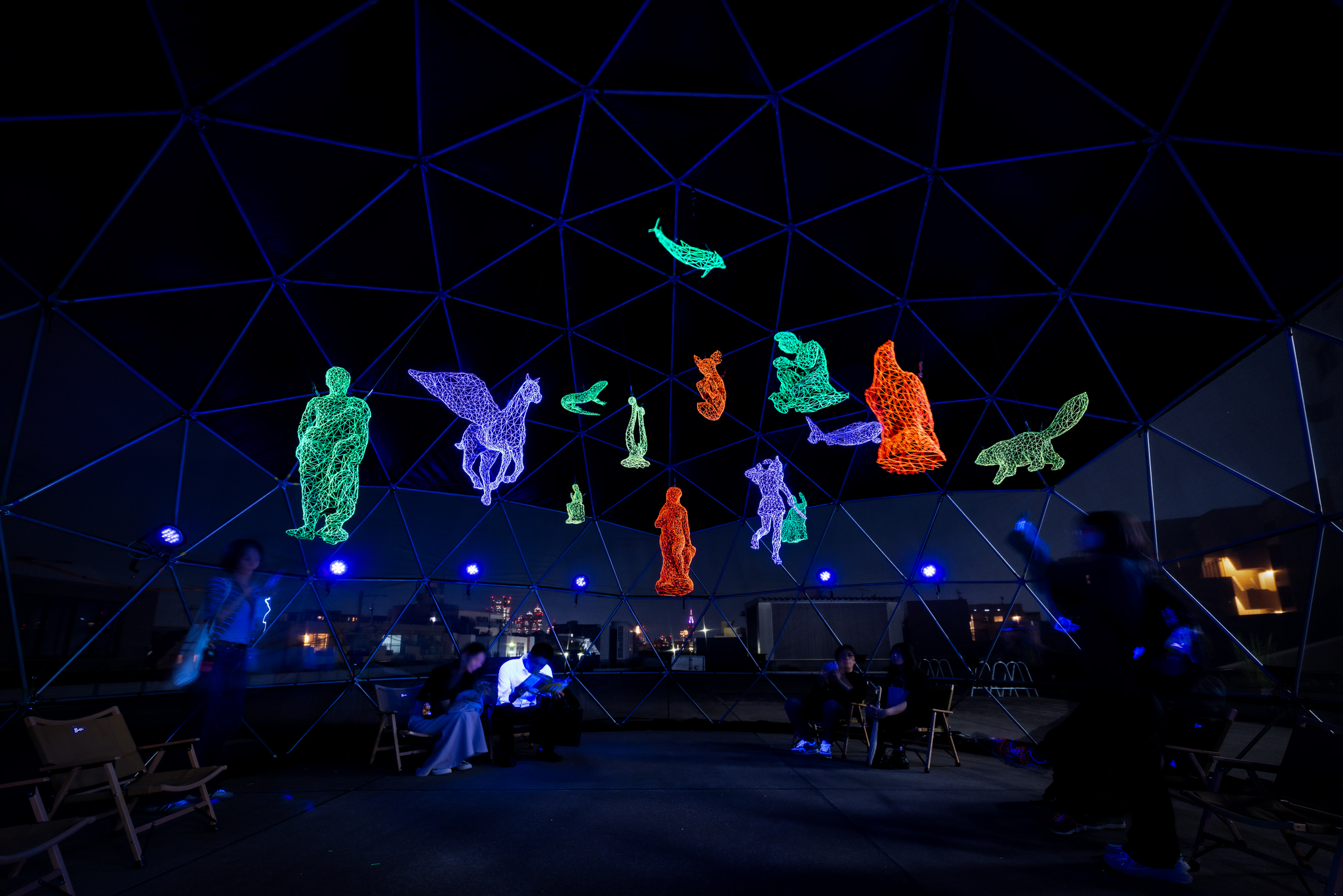
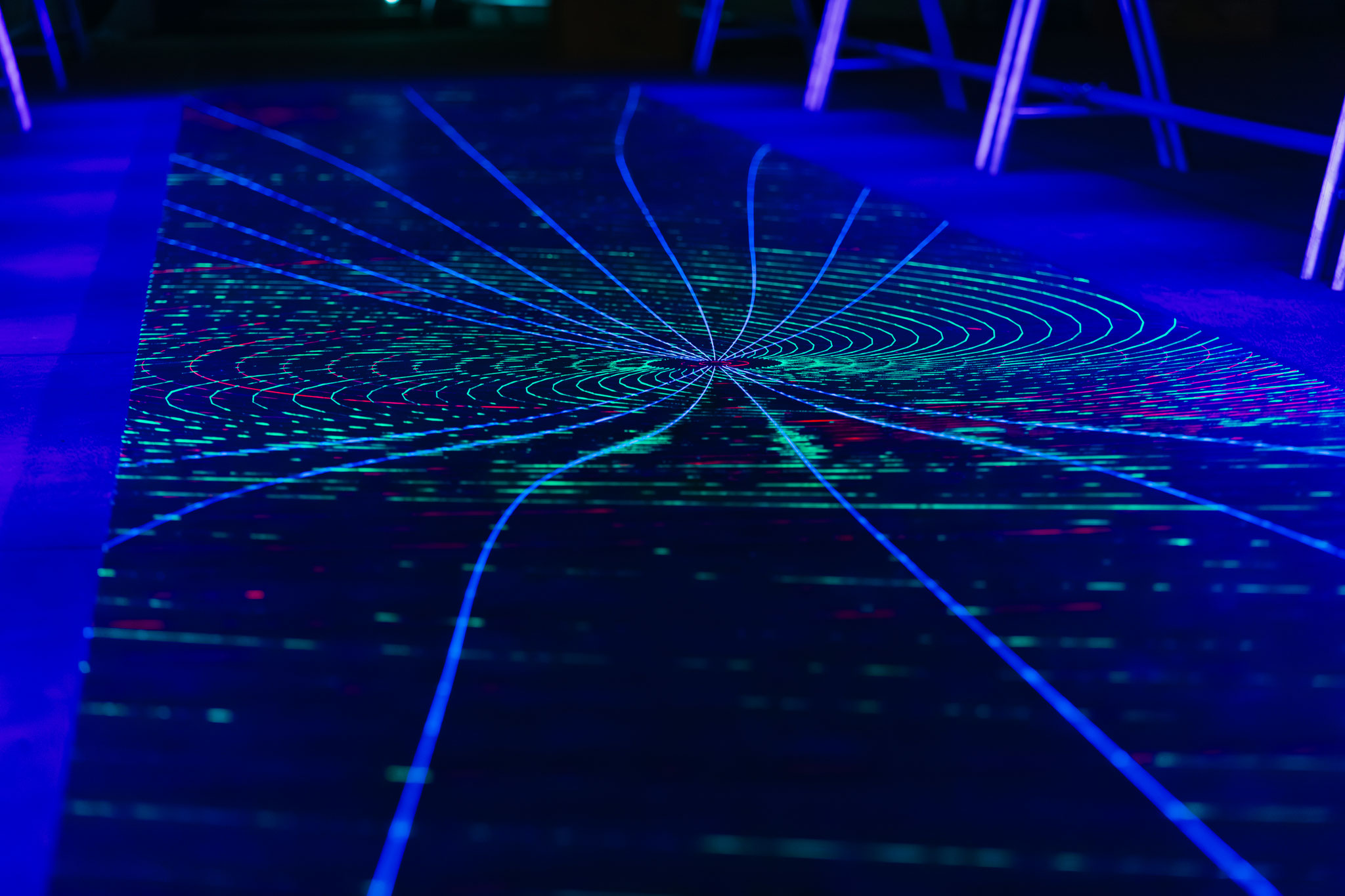
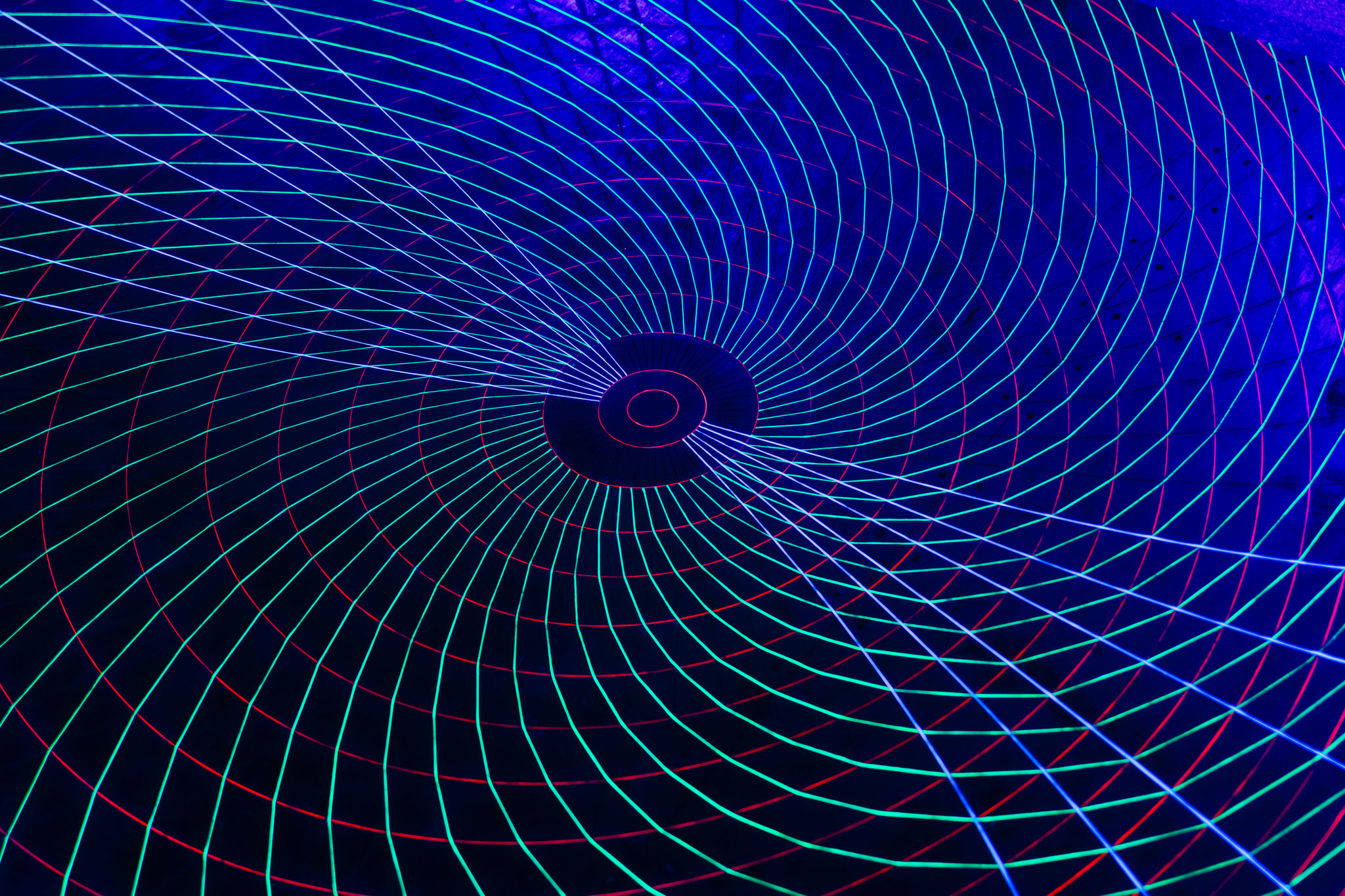
order of the world. In this work, constellation motifs are drawn within a celestial dome using threads that fluoresce in response to ultraviolet light. From the 88 constellations
defined by the International Astronomical Union, I selected approximately twenty that can be observed from Tokyo around September, when the exhibition took place. By visualizing the invisible
“imaginary lines” that connect stars into constellations, the boundary between reality and imagination begins to waver, gently stirring our perception.
Technically, the process begins by converting constellation data into polygonal forms using 3D software. These are then 3D-printed to create constellation objects. Pins are inserted at each
polygon vertex, and fluorescent threads reactive to ultraviolet light are stretched between them. In the darkness, the constellations emerge as glowing polygonal sculptures. This process—moving
back and forth between digital and analog, between contemporary technology and handcraft—forms an essential part of the work’s character.
To gaze up at these polygonal constellations floating quietly inside the dome is to recall the ancient human act of connecting stars to weave stories—an activity that has continued across
thousands of years and cultures. Ancient people, contemporary viewers, and people around the world today all look up at the same stars and continue to imagine narratives within them. Although the
constellations visible may differ by region, the act of imagining and storytelling through the stars is universal. It is my hope that this shared experience resonates across time and borders as a
quiet prayer for empathy and peace.
The title Uranometria combines "urano" (sky or universe in ancient Greek) and "metria" (measurement), referencing the star atlas published in 1603 by Johann Bayer. By visualizing
humanity’s enduring imagination through the geometric language of polygons, this work seeks to measure and gently experience the order and structure of the cosmos.






3D-printed resin, pin, fluorescent threads, plywood, ultraviolet light
Moon Art Night Shimokitazawa [Higashikitazawa Station / Tokyo, Japan] 2025
Photo: Masataka Tanaka and others